The British Museum: How to Make the Most of a Free World-Class Collection
- Free cancellation up to 24 hours ahead
- Reserve now, pay later
- Wheelchair accessible
The British Museum is one of the greatest museums on earth, free to enter, and genuinely overwhelming in the best way. Eight million objects. Two million years of human history. Eighty galleries. The impulse to see all of it is natural and should be resisted firmly. Plan to see ten things well rather than fifty things badly — this will give you a far better experience and leave you wanting to return, which is the correct response to a collection this good.
Highlights
- Uncover the story of human culture with a licensed guide through one of the world's oldest museums
- See the Rosetta Stone — the key to deciphering Egyptian hieroglyphics
- Marvel at the Great Court's glass ceiling, the largest covered square in Europe
- View the Parthenon Sculptures, still the subject of an active repatriation dispute with Greece
- Explore the Sutton Hoo burial relics and the Anglo-Saxon collection
What to See, Room by Room
Room 4: The Rosetta Stone
The single most visited object in the museum. The Rosetta Stone is a fragment of a granodiorite stele inscribed in 196 BC with a decree issued by King Ptolemy V, written in three scripts: Ancient Egyptian hieroglyphs, Demotic Egyptian, and Ancient Greek. When it was discovered by a French soldier near the town of Rosetta (Rashid) in the Nile Delta in 1799 — during Napoleon's Egyptian campaign — it was immediately recognised as potentially significant. After Napoleon's defeat, it was surrendered to the British under the Treaty of Alexandria in 1801 and has been in the British Museum since 1802.
Its significance: because Ancient Greek was well-understood by scholars, the stone became the key to deciphering Egyptian hieroglyphics, which had been unreadable since the 4th century AD. Thomas Young made the first breakthroughs in 1814; Jean-François Champollion completed the decipherment in 1822, unlocking the entire written record of ancient Egyptian civilisation. The stone didn't just provide a translation — it opened an entire culture.
The object itself is smaller than most people expect (112 cm × 76 cm) and usually surrounded by people taking photos. Go first thing when the museum opens. There's also a full-size replica in the Roxie Walker Galleries — usually with far fewer people around it and just as useful for actually looking at the text.
Room 18: The Elgin Marbles (Parthenon Sculptures)
Whatever you think of the political question (and you'll have a view by the time you leave), the sculptures themselves are extraordinary. The Parthenon in Athens was built between 447 and 432 BC and decorated with a continuous frieze running around all four sides of the building — 160 metres of carved marble depicting the Panathenaic procession. The British Museum holds 75 metres of it, along with sections of the metopes (the carved panels on the outer colonnade) and pedimental sculptures from the east and west ends.
The quality of the carving is stunning — the drapery on the female figures, the musculature of the horses, the sense of movement frozen in stone. These were carved 2,400 years ago. The gallery is beautiful and relatively uncrowded compared to the Egyptian rooms.
Greece has formally requested their return since the government of Melina Mercouri in 1983. The museum's legal position is that the British Museum Act 1963 prevents the Trustees from permanently removing items from the collection. The debate about what this law should say, and whether it should be changed, continues.
Room 40: The Lewis Chessmen
Discovered in 1831 on the Isle of Lewis in the Outer Hebrides, probably in a sandbank or small stone building, the Lewis Chessmen are 93 medieval chess pieces carved from walrus ivory and whale tooth. They date from the 12th century (probably 1150–1200) and are thought to have been made in Trondheim, Norway, though possibly in other Scandinavian workshops. They were probably a collection of several chess sets, not a single one.
The pieces are wonderful: the kings and queens sit in formal, stiff poses; the bishops bless with hand raised; the knights ride tiny, unhappy-looking horses; the warders (rooks) bite their shields in apparent battle fury; the pawns are simple obelisks. 82 of the 93 known pieces are here. The other 11 are in the National Museum of Scotland in Edinburgh, which makes a legitimate argument that they should be displayed in Scotland — another unresolved institutional dispute.
Room 33: Chinese Collection
Less visited than the Egyptian and Greek galleries, and all the better for it. The collection spans 7,000 years and includes extraordinary Tang dynasty tomb figures (618–907 AD) — sancai glazed ceramics of horses, camels, and court ladies that retain astonishing vivacity. The Song dynasty porcelain, the Shang dynasty bronzes, and a series of gigantic Buddhist sculptures from northern China are all exceptional.
Room 63: Sutton Hoo Helmet
In 1939, a local landowner named Edith Pretty hired archaeologist Basil Brown to excavate some burial mounds on her estate at Sutton Hoo in Suffolk. What they found under Mound 1 was a 27-metre Anglo-Saxon ship burial dating to around 625 AD — the richest early medieval grave ever found in Britain. The ship itself had long since rotted away, leaving only a ghost of rust stains in the sand, but the burial chamber at the centre was intact.
The helmet is the centrepiece: a full-face iron helmet with bronze attachments, gilded and decorated with intricate interlace patterns. The eyebrows form a moustache over a beaked nose — the face takes on a fierce human expression. Nobody knows whose helmet it was. The most likely candidate is Raedwald of East Anglia, the most powerful king in England in the early 600s, who appears in Bede's Ecclesiastical History.
Edith Pretty donated the entire find to the British Museum in 1939 — one of the most generous private donations in the museum's history. The helmet is housed in Room 63 and is, by common consent, one of the most extraordinary objects in the building.
The Great Court
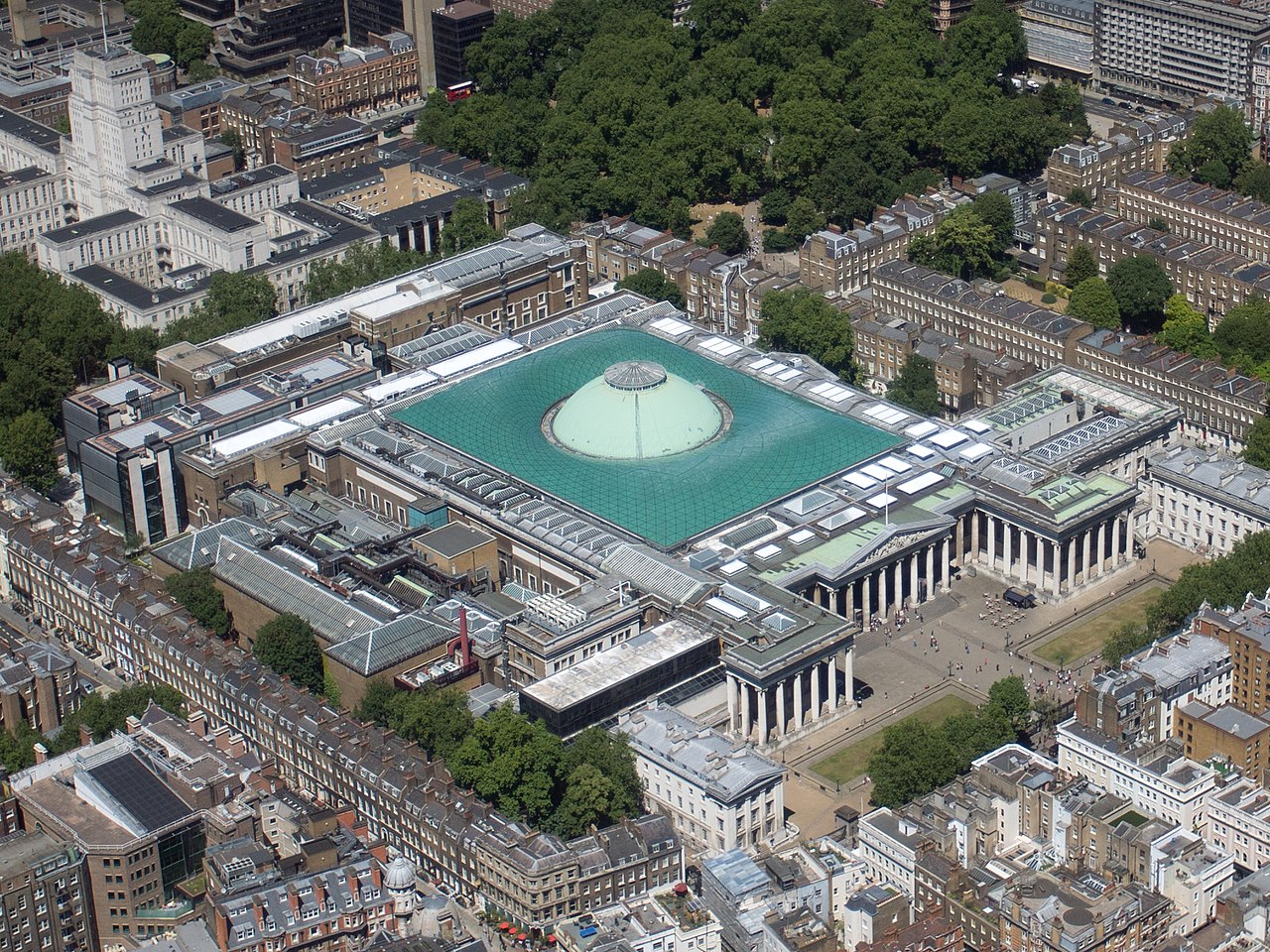
Walk in through the main entrance on Great Russell Street and you'll find yourself in the Great Court — a vast glazed atrium designed by Norman Foster and opened in 2000. It's the largest covered public square in Europe: 100 metres across, roofed in 3,312 unique triangular glass panels. The circular Reading Room in the centre was built in 1857 and is where Karl Marx wrote Das Kapital, where Lenin researched during his London visits, where Mahatma Gandhi, Oscar Wilde, and Virginia Woolf all worked. The room is now used for occasional exhibitions.
Even if you're pressed for time, stand in the Great Court for ten minutes. It's one of the best interior spaces in London.
Want the highlights covered for you? A guided tour hits the Rosetta Stone, Elgin Marbles and Sutton Hoo Helmet with expert context in about 2 hours.
From £17Insider Tips
Go on a Tuesday or Wednesday morning. These are consistently the quietest days. Summer weekends and bank holidays can be overwhelming — not dangerously so, but the Egyptian rooms particularly get very crowded and the experience suffers.
The Rosetta Stone has a replica. The replica in the Roxie Walker Galleries has no crowd around it and is exactly as useful for reading the text. Go to the original first thing, then revisit the replica if you want to look properly.
Free guided tours. The museum runs free highlights tours daily — check the website for times (usually 11:30am, 1pm, and 3pm). The volunteer guides are knowledgeable and the tours are an efficient way to hit the major points with context.
Don't eat at the Great Court restaurant. It's expensive and unremarkable. Museum Street, directly outside the main entrance, has better options: Abeno on Museum Street for okonomiyaki, Noble Rot on Lamb's Conduit Street for excellent wine and food, or Holborn Dining Room on High Holborn for a proper British meal.
The cloakroom. Large bags aren't permitted in the galleries. The cloakroom (free) is inside the main entrance — use it, you'll move more freely.
What to Skip on a First Visit
The Ancient Egypt galleries (Rooms 62–66) are often given disproportionate time by first-time visitors because of name recognition. The mummies are interesting, but these rooms get extremely crowded. Hit the Rosetta Stone in Room 4 first thing, then come back to the mummies when you've covered the highlights. If you're pressed for time, Room 63 (Sutton Hoo, also medieval Europe) is usually much quieter and contains equally extraordinary objects.
The museum's clock collection, coin collection, and some of the more specialist rooms reward deep knowledge of their subject area but are hard to appreciate on a first visit. Save them for return trips.
Special Exhibitions
The British Museum runs major ticketed special exhibitions throughout the year, typically in the Sainsbury Exhibitions Gallery at the back of the Great Court. These usually cost £20–25 and focus on a particular civilisation, period, or theme. Recent exhibitions have covered ancient Egypt, the Byzantine Empire, silk, and Roman Pompeii. They're genuinely excellent when the subject interests you.
The permanent collection is the main event — don't shortchange it by spending your time on the paid exhibition if it's not on a subject that excites you. But if it is: book online in advance, as popular exhibitions sell out weeks ahead.
Practical Information
Opening hours: Daily 10am–5pm (last entry 4:30pm). Friday until 8:30pm (selected galleries only). Closed 24–26 December and 1 January.
Address: Great Russell Street, WC1B 3DG. Nearest tube: Tottenham Court Road (Elizabeth and Northern lines) or Russell Square (Piccadilly line).
Free timed slots: Book a free timed entry slot on the British Museum website. It doesn't cost anything and means you arrive to a managed entry rather than a queue. Worth the 2 minutes it takes to do it.
British Museum: Frequently Asked Questions
The permanent collection is completely free — no ticket required, no suggested donation box at the door. Special exhibitions (usually in the Sainsbury Exhibitions Gallery) cost extra, typically £20–25. You should book a free timed entry slot online, especially for weekends and summer — the museum has been managing visitor numbers since the post-pandemic reopening.
90 minutes if you're doing the highlights efficiently. 3–4 hours if you want to go deeper. The museum is genuinely enormous — if you tried to spend one minute at every item in the collection, it would take you 30 years. Plan to see 10 things well rather than 50 things badly.
The Rosetta Stone (Room 4), the Elgin Marbles/Parthenon Sculptures (Room 18), the Sutton Hoo Helmet (Room 63), the Lewis Chessmen (Room 40), and the Great Court itself. On a first visit, start in Room 4 and work your way through the Egyptian, Greek, and Medieval galleries.
Very busy on summer weekends and during school holidays. Tuesday and Wednesday mornings are consistently the quietest. The Rosetta Stone is always surrounded by people — go first thing, or use the replica nearby which gets a fraction of the traffic. The museum's outer galleries (Rooms 40–73) are significantly quieter than the ground floor Egyptian rooms.
The Elgin Marbles — officially called the Parthenon Sculptures — are marble sculptures that formed part of the Parthenon in Athens, built around 447–432 BC. Thomas Bruce, the 7th Earl of Elgin, removed them between 1801 and 1812 while serving as British ambassador to the Ottoman Empire (which then controlled Greece). Greece has formally requested their return since 1983. The British Museum has consistently refused, citing the Trustees' legal inability to de-accession items and arguing that London allows them to be seen 'in the context of world history.' This remains one of the major unresolved questions in museum ethics.